Your Shopify store is your business.
So one of the first questions any brewery owner has before hiring me is the one with a real cost attached: will you break it.
A broken checkout during a Friday release isn't an inconvenience. It's lost sales, money that never arrives, customers walking away frustrated, and a night spent untangling it. I run a Shopify store too, so this is the fear I take most seriously. The answer isn't "trust me, I'm careful." It's the way the work is structured so that the parts of your store already making money are kept separate from the part I'm adding.
If you haven't yet, it's also worth reading how I take access to your store in the first place, and why your revenue and customer data stay invisible to me throughout: How you give me access to your store without exposing your data.
Here's how the system actually goes in, step by step.
The Beer Club page I build is a self-contained section called a "custom HTML/Liquid" section.
In plain terms, that's a sealed block of code that sits in its own box. It doesn't reach into the rest of your store, doesn't change how your existing pages look or behave, and doesn't touch your checkout. It's added alongside what you already have, not woven through it. Building it has no path to affect the parts of your store that are already selling.
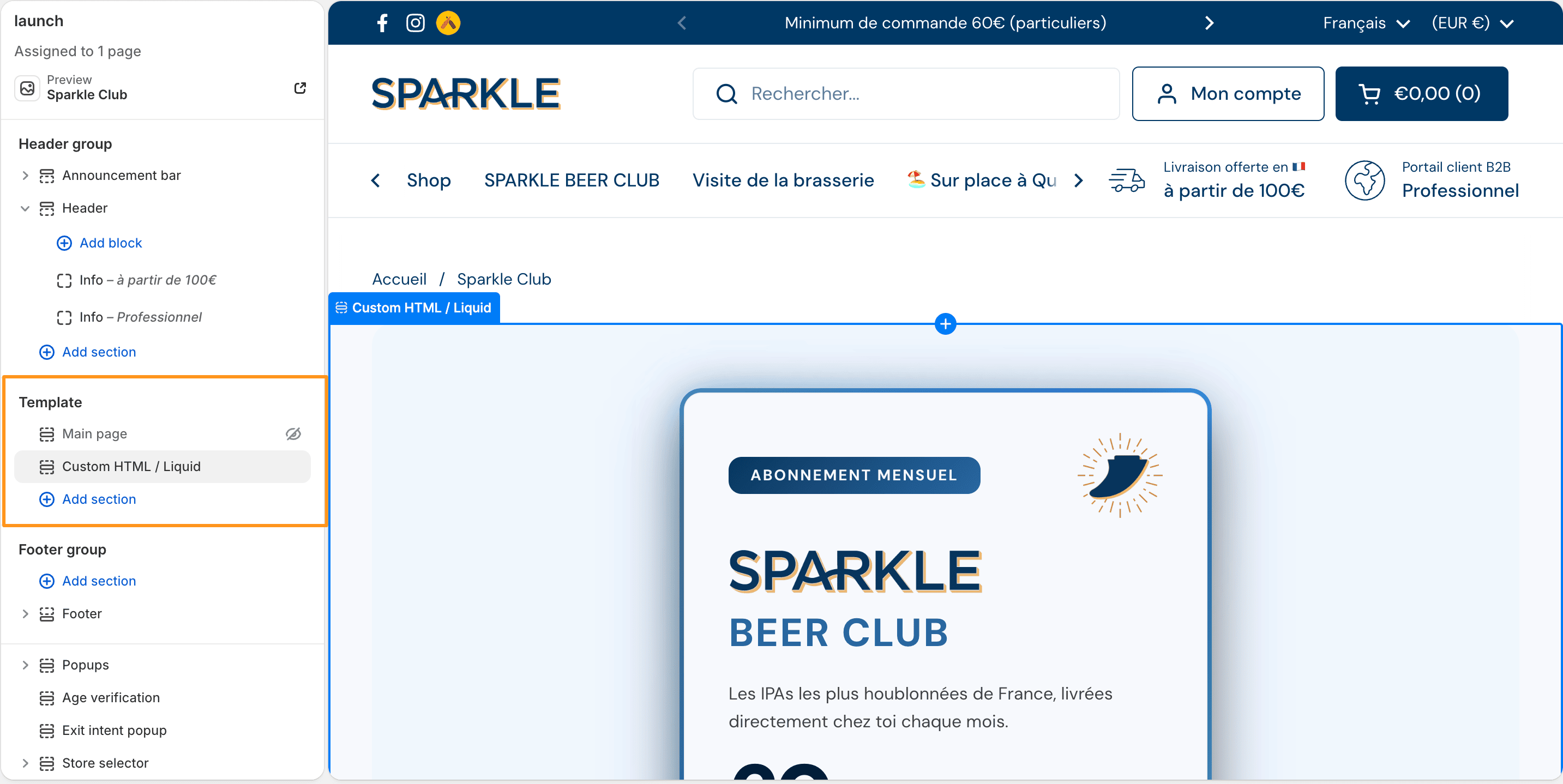
(Sorry if you're reading this on a smartphone, you'll need to zoom in for the screenshots...)
There's one part of any web page that could, in principle, affect more than its own box, and that's CSS, the layer that controls how things look.
Done carelessly, a style written for one page can bleed into another and quietly shift a button or a heading somewhere else. So I handle it two ways. For fonts and sizes, I match what your site already uses, so the Beer Club page feels like it belongs to the same store rather than something glued on. For everything custom to the page (the layout, the buttons, the specific design choices), I write styles that only apply to the Beer Club page itself. They can't reach the rest of your store. Your homepage and your product pages keep looking exactly the way they look today.
That matters because the usual way things break is when new code reaches into old code and something downstream gives way. A self-contained section can't do that. If it had a problem, the problem would live inside its own box, on a page nobody can reach yet, not on your homepage or your product pages.
That section sits on a page that isn't linked anywhere: not in your menu, not in your navigation, not on your homepage. A customer browsing your store has no way to arrive at it. There's simply no door leading there. While I build, your store runs exactly as it did yesterday.
I'll be precise about what "invisible" means here, because you're technical enough that I'd rather be exact than reassuring. The page isn't in any path a customer would follow, and it's not promoted or advertised anywhere. It's hidden in the practical sense that matters: no one stumbles onto it. What it isn't is sealed behind a password. So the honest line is this. Your customers won't find it, and nothing they can find is altered while I work.
Going live means linking the page and announcing it. That's a single action, taken once, and only after you've seen the finished thing and said go. Nothing the public can see changes until that moment. Up to then, the whole build is sitting quietly on a page they can't reach.
There's one part that doesn't happen inside the theme: setting up subscriptions means installing and configuring Recharge, wiring your monthly product, and connecting your email tool. That happens in your Shopify back office and inside those apps, the back room rather than the shopfront. It can't break the page a customer is checking out on, because it isn't part of that page.
Fair. Access plus silence is how you end up staring at a black box wondering what's happening to your store.
So the build isn't silent. It's four weeks, structured week by week, with a checkpoint each week. You see what's been built, you say what's right and what's off, and the next week moves on that. It's not a vanish-for-a-month-and-reveal situation.
And at handover, the whole system is yours: the code, the design, the email templates, the configuration. If something breaks later, or you'd rather I stay on and keep building with you, that's a choice you make after launch, not a string attached to getting in the door.
Here's what actually happens by launch day.
You don't flip a switch and pray. For four weeks you've watched your Beer Club get built, piece by piece, on your own store. You've seen the page. You've clicked through the customer portal. You've approved each part before it moved. By the time anything goes live, there's nothing left to take on faith. You've already seen it work.
That's the point of building this way. Not to ask you for trust up front, but to make trust unnecessary. The leap of faith everyone dreads at the start turns out not to exist, because by the end you've watched the whole thing get built in the light.
If you want to see exactly what access I take to make this happen, and how your revenue and customer data stay off-limits the whole time, read How you give me access to your store without exposing your data.